The male potency vertical is familiar to virtually everyone who has worked with Nutra. Potency offers have remained one of the industry's classic directions for years.
But what about female libido?
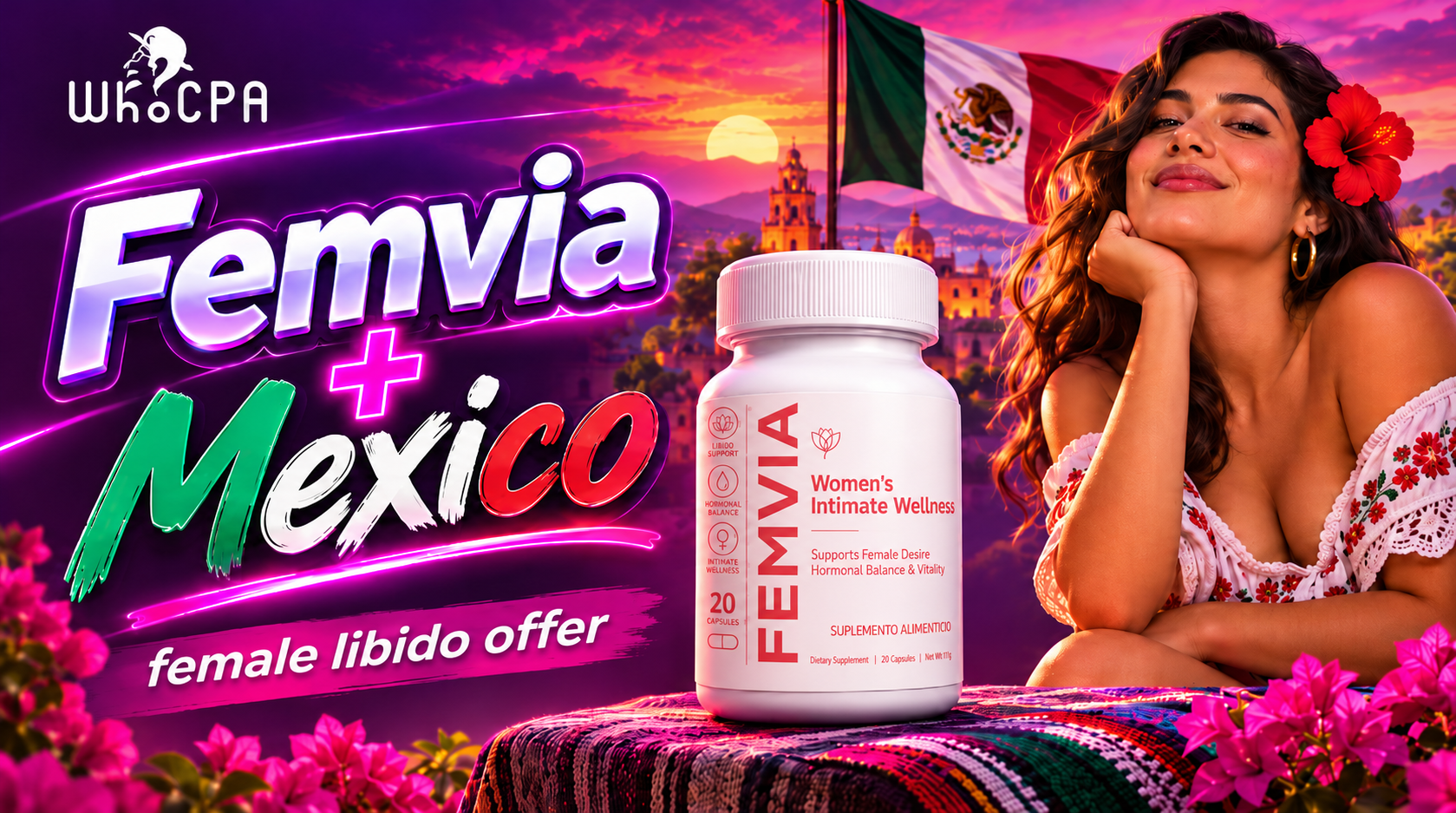
Today, we take a closer look at Femvia [MX] — an offer in the Female Libido category, or more simply, “Female Viagra”, for the Mexico GEO.
Mexico is part of Latin America, and the image of passionate and temperamental Latina women has long been part of popular culture.
But let's leave the stereotypes to the creatives. We are more interested in the numbers.
How often do Mexican women actually experience low sexual desire? Do they talk about it with doctors? And how common is it for them to look for solutions on their own?
Let's take a closer look at the Femvia audience.
Almost 30 million women aged 20–49
According to demographic data from the United Nations Population Division, Mexico has around 66.8 million women.
Looking at age groups potentially relevant to the Female Libido vertical:
20–29 — 10.82 million women
30–39 — 10.15 million
40–49 — 8.86 million
This means that the 20–49 age group alone includes approximately 29.82 million women.
There are also around 16.03 million women aged 40–59.
The calculation is based on five-year age groups from the UNICEF / United Nations Population Division demographic tables.
So the potential Female Libido audience is far from being a niche segment.
What about low libido?
This is where things get more interesting.
A Mexican study conducted at Hospital General Dr. Manuel Gea González in Mexico City surveyed 171 women aged 20–60 using the Female Sexual Function Index.
Overall, female sexual dysfunction was identified in 35% of participants.
The most common individual issue was:
low sexual desire — 28%
For comparison:
arousal problems — 17%
orgasm difficulties — 17%
insufficient lubrication — 11%
pain during sex — 11%
Another important figure: among women over 40, sexual dysfunction was identified in 66% of the sample.
Of course, this was a study of 171 women, not national statistics for all of Mexico, so it would be incorrect to apply the 28% figure to the country's entire female population.
Still, the sample is highly informative when it comes to understanding the issue itself.
After 40, the issue becomes even more relevant
Another Mexican study specifically examined 110 women aged 40–59.
Among sexually active participants, 62.1% had sexual dysfunction.
Researchers also found that sexual function scores worsened with increasing age, particularly after 50.
This creates an interesting picture:
There are more than 16 million women aged 40–59 in Mexico, while local clinical studies show that sexual function issues are far from rare within this age group.
And the issue is noticeable even among younger women
There is also a much more recent study.
Between 2023 and 2024, a Mexican branch of Instituto Mexicano del Seguro Social examined 381 sexually active women aged 20–44.
In this specific clinical sample, female sexual dysfunction was identified in 71.12% of participants, while low sexual desire was the most common dysfunction.
In the 38–44 age group, sexual dysfunction was identified in 78.61% of women, and among women in this group with diagnosed dysfunction, 89.6% experienced low sexual desire.
Again, this was 381 patients from one medical institution, not a representative study of the entire country.
But several different Mexican samples point in the same direction:
Female Libido is not an invented problem created simply to sell a Nutra offer. There is a very real audience behind it.
But do women talk about it with doctors?
This is where another interesting audience characteristic appears.
The authors of a 2025 Mexican study directly note that only a small proportion of women visit their family doctor specifically because of sexual complaints.
Among the reasons, they cite social taboos, insufficient sexual education, and underdiagnosis of female sexual dysfunction.
This creates an interesting paradox: the issue may be common, but not every woman is willing to visit a doctor and openly say:
“My sexual desire has decreased.”
For products that can be found and ordered independently, this is an important behavioral characteristic of the GEO.
Mexican women are familiar with home and natural remedies
And this is already part of Mexican culture, long before Nutra ever existed.
In 2023, Scientific Reports published a major review of Mexican Traditional Medicine in the context of women's health.
Researchers collected data on 185 medicinal plant species from more than 60 botanical families used by Mexican women for various reproductive health issues.
Depending on the region, the authors estimate that approximately 12–60% of Mexican women rely on traditional medicine and herbal remedies for primary healthcare needs.
In one of the studies included in the review, 59.4% of pregnant women used herbal or conventional medicines on their own, with recommendations often coming not from doctors but from friends and relatives.
These figures do not relate directly to libido, so they cannot be attributed specifically to Femvia.
But they demonstrate something else: for Mexican female audiences, the model of “finding a remedy and using it independently at home” is far from unfamiliar.
What about purchasing power?
According to INEGI ENIGH 2024, the average monetary income of a woman in Mexico was MXN 21,723 per quarter, or approximately MXN 7,241 per month.
However, income is higher among the core adult audience:
20–29 — MXN 20,982 per quarter
30–39 — MXN 27,458 per quarter
40–49 — MXN 27,173 per quarter
50–59 — MXN 23,949 per quarter
So women aged 30–49, one of the most interesting segments for the Female Libido vertical, earn approximately MXN 9,000 per month in personal monetary income on average.
What does all of this mean for Femvia?
Affiliates are looking at a rather unusual vertical, but one with a very large audience.
29.8 million women aged 20–49.
16 million women aged 40–59.
In local Mexican studies, low sexual desire repeatedly appears among the most common sexual health issues, while the overall prevalence of sexual dysfunction rises significantly after 40.
At the same time, the subject remains private enough that many women may not want to discuss it openly with a doctor.
Add to this Mexico's long-standing culture of home-based and herbal solutions, and the concept of a female libido product starts to look much more natural for this GEO than it may initially seem.
Femvia [MX] at WhoCPA
The male potency vertical has long been familiar to affiliates.
Female Libido is a much less saturated direction.
Femvia gives affiliates the opportunity to test it in one of the largest LATAM GEOs — Mexico.
Femvia [MX] is available for testing at WhoCPA.